Tag Archives: chess middle game

Chess tips: Essential tips for beginners to control middle game

3
Filed under Guest Posts
Tagged as beginner chess, Beginner Chess Tips, ches tips, chess, chess games, chess middle game, middle game chess, middle game chess tips, middle game strategy

Guest Post by Paul

The most interesting and challenging part in the fascinating game of chess is the middle game. It is this part of the game that would witness the real battle between the minds of two players of same capability. Ironically, it is this part of the game for which there is not much literature or straight-forward short-cut formula that one can adopt. With constant practice, however, one can gain experience and expertise in the middle game strategies. Using online chess or playing chess using the computer and the Internet in online chess websites is one of the best ways to learn the game and also gain expertise in a relatively quicker time.

What is the middle game? Where it starts and where it ends? There is no concise answer for these questions. One can say that the middle game starts when the opening game ends and the middle game ends when the end game starts. This seems to be vague, but, in most cases, it is sadly true because there is very thin line of difference and there is not much clarity.

Typically, the opening game should come to an end in less than 12 moves by which a player is reasonably expected to have developed his pieces and taken positions. But that seldom happens in the game and there is no set rigid rule that signals the beginning of the middle game.

The middle game is the real battlefield in the game where one is expected to use all his knowledge and thinking capability to the maximum extent. It is a minefield full of tactics and strategies.

To have a better and challenging middle game, it is imperative that you have a good opening game where the major pieces are well developed, the king is in a safe and secure place, and there is enough scope for free movement of the pieces. If there is some inherent weakness in the opening game, then it is unlikely that you can have better control over the middle game.

I would like to share with you some of the tips that would be of help to you in approaching the game with confidence.

In majority of cases, the opening game follows some of the time-tested and proven opening theories or opening variations such as French Defense, Roy Lopez opening, King’s gambit, Caro-Kann etc., Many people would have memorized the first few moves of each variation and can move the pieces to appropriate square, with no second thought, in a flash. But this can be followed only for the opening part. Once you enter into the middle game stage, you should start thinking a bit more deeply and concentrate more on the positional advantages of the various pieces.

You need to think not about the materials on hand, but also the positional advantages of the pieces. For example, if you have your queen side bishop at c1 and the king pawn in e2 moved to e3. If there is also a pawn at b2, then your white bishop is cramped as it can move only to d2 square and nothing more can it do. Thus not just the material but also the position of the pieces and their merits and drawbacks relative to the position should be assessed and analyzed, so that you can chalk out your plans well.

Before zeroing on a particular move, you should, for a split second, place yourself in opponent’s shoes and see what type of response can he give to your moves. This analysis and consequences of the opponent’s response should also be analyzed and then proceed with your decided move.

You should also use the analytical ability and foresight for planning your next 2 or 3 moves. Having planned for the next couple of moves, you can proceed further in the middle game with confidence. However, you should always bear in mind that a plan should not be a rigid one. The success or failure of your next planned move is dependent not on your plan but mainly on the response from the opponent’s move in his turn. If he foils your plan or makes a counter attack, you have no other option but to put your present plan to the back-burner and start working on a new plan. This does not mean that you should cease from planning your moves. By careful planning, you will get a better perspective of the game, which is essential for deploying tactics and strategies.

Chess tactics : Importance of controlling the d4 square in middle game

3
Filed under Chess Strategy
Tagged as chess, chess middle game, Chess Strategy, Chess tactics, chess tips, d4 sqaure, middle game tactics, square strategy

In the game of chess, the middle game plays a very important role. It is in this stage that the fate of the game is effectively decided and involves a series of tactics and strategies to attack and counter attack the opponent. A good opening paves for an intriguing contest in the middle game. Many chess players, in their early days of playing chess, ignore the pawns or do not realize the importance of pawns and sacrifice their pawns very cheaply. If one were to improve the skills and graduate himself to higher levels such as International Master or Grand Master in Chess, then he or she should have all-round skills – both positional skills and tactical skills – and should be in a position to evaluate each and every position according to its due merit and capability.

One of the major aspects in an opening is to have a fair control over the center board – any one or all of the four squares in the center – d4, d5, e4 and e5.

It is quite possible that as a result of a kind of opening you might be following, you might end up with an isolated queen pawn while playing black pieces. Isolated Queen Pawn refers to the queen pawn of black located at d5 square with no points in either files to support it. Having such a position might turn out to be very advantageous in some cases and at the same time might also turn out to be a hindrance. But effective tactics can help you reap the benefits of that isolated queen pawn in d5, and also pave way for controlling the all-important d4 square in the board. It is needless to say that one who has effective control over the d4 square can exert more pressure on the white pieces and ensure that with reasonable tactical skills aspire for victory over the opponent.

Let us try to understand the importance of controlling the d4 square with the help of this game played between two grandmasters.

This is the position after 15 moves. It is the turn of white to move now.
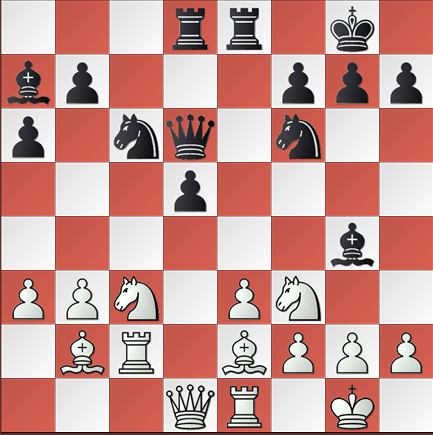
chessgraph

(White to move)

The black pawn at d5 is the Isolated Queen Pawn, as it has no pawns in the “c” file and the “e” file. Black pieces are fairly developed and the key d4 square is in the control of the black. Though white’s knight at f3 and pawn at e3 also attack the d4 square, they are pinned by the black light squared bishop at g4 and the rook at e8 respectively.

Realizing the importance of the d4 square, white tried to win back the control, but his attempts proved futile by the smart play of black.

The game continued as follows :

16. Rd2 …. White tried to wrest control over the d4 square. However, some very interesting attacking play by Black nullified the efforts and black takes control over the game as can be seen below
16. …. d4
17. Nxd4 Nxd4
18. exd4 Bxd4
19. Bxg4 Rxe1+
20. Qxe1 Nxg4

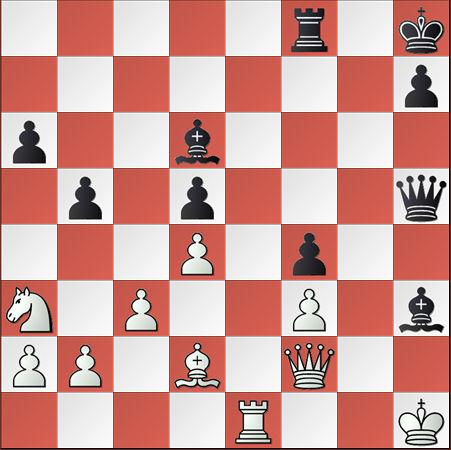
The position after 20 moves is given below:
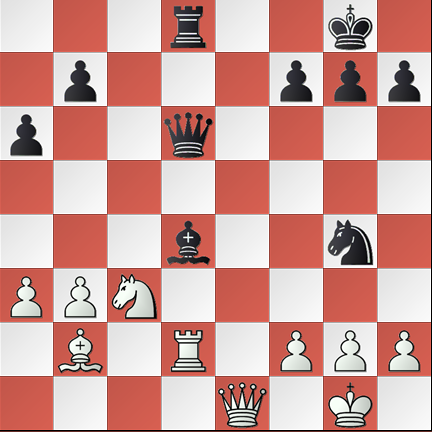
chessgraph2

(White to move)

As you can see, black has not only wrested control over the vital d4 square, but its pieces have pierced into White’s territory and are very interesting positioned to go for all out attack.

The game proceeded further as detailed below, but the result was never in doubt and it is black which having effective control over the vital d4 square is likely to emerge victorious barring any foolish mistakes on his part.

21. Ne4 Qxh2+
22. Kf1 Qh1+
23. Ke2 Qxg2
24. Kd1 Qf3+
25. Qe2 Qh1+
26. Qe1 Qf3+
27. Qe2 Qxb3+
28. Ke1 Ne5
29. Ng5 Bc3

0 – 1

This is an interesting game underlining the importance of having control over the d4 square, the opportunity for the same being provided by the Isolated Queen Pawn.
Middle game tactics: Identifying your weakest piece is essential

10
Filed under Chess Strategy
Tagged as chess game analysis, chess middle game, Chess Strategy, Chess tactics, chess tips, chess tutorial, weak piece, weakest piece

In the game of chess, the most interesting and intriguing part is the middle game, in which both the players vie for positional control and shrewd tactics to gain an upper hand over the opponent. Typically, it is that part of the game where all the major and minor pieces are in the process of being deployed and or stationed in interesting squares as part of the attack and / or defense. The middle game also gains importance in that it is the stage where utmost calculation and concentration is required, and any wrong move or not a correct move might lead to losing control or giving an edge to the opponent.

In such cases, it might quite often happen that you might be caught in a dilemma as to which piece to move or how to go forward in the execution of tactics. This is possible, especially when most of your pieces are in favorable positions and having a tight leash on the opponent’s pieces while at the same time safeguarding your King and other pieces. It is in such times that the technique or trick of identifying your weakest piece among the active pieces comes to your assistance.

Let us try to explore this simple concept of identifying the weakest piece with the help of an interesting game played between two grandmasters in a European team Championship during 1999.

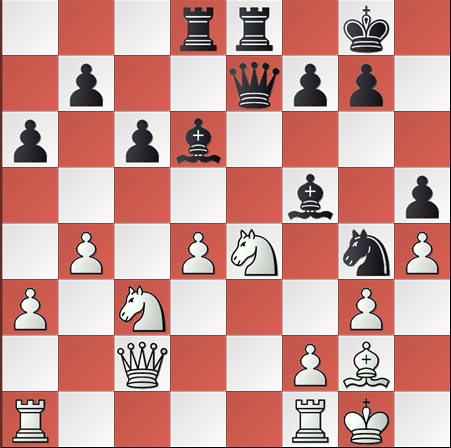
The position of the board after 20 moves by White is given below. It is the turn of black to move.

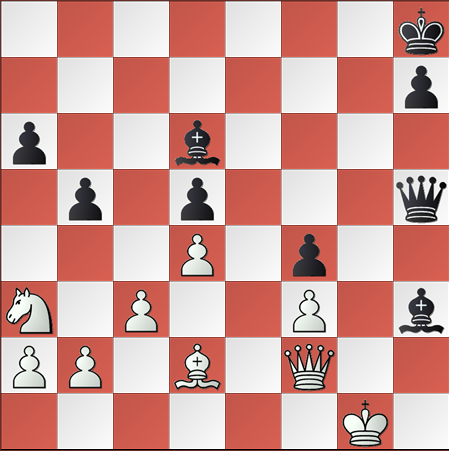
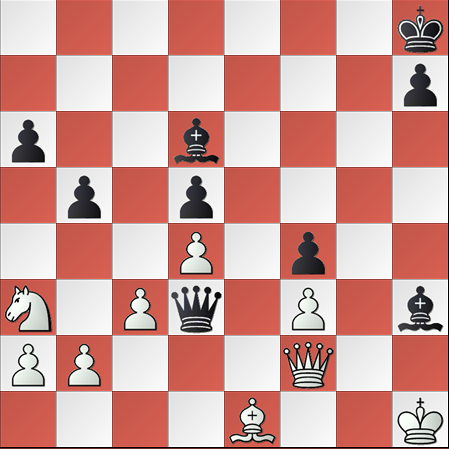
chess_image1

(Black to move)

A cursory look at the position of black’s pieces reveal that its major and minor pieces are fairly developed and exerting pressure on White. Also, there is not much scope for the black pawns to make any move that might turn out to be advantageous. He is presently caught in a dilemma as how to go forward with his next move. What is the option available to him now.

A second look of the major and minor pieces is warranted before any meaningful outcome regarding his next move. The light-squared bishop is acting as a pin for the White queen and making White’s Knight immovable without the White queen being moved to safety. The black knight at g4, having effective control over the f6 and h6 squares is taking care of the safety of the kingside. The two rooks are fairly centralized and the rook at e8 is providing additional support to the Queen at e7. This analysis reveals that the dark-squared black bishop is the one that can be considered for the next move. Zeroing on the dark-squared bishop also reveals that, but for its occupation of the d6 square, the rook at d8 might have captured the white pawn on d4. A critical analysis of this type will provide instant clues to make the most effective move. Also, the white king at g1 provides the clue that the diagonal a7-g1 might be explored for the dark-squared bishop, if he switches the angle. Black did the same and the game followed as follows:

20. ,,,, Bb8
21. Rad1 Ba7 White tried to protect the d4 pawn with additional support, but the damage had already been done and White might have to lose his pawn in d file.
22. d5 …. His futile attempt to protect his pawn in d file was thwarted.
22. …. cxd5
23. Nxd5 Rxd5
24. Rxd5 Bxe4
25. Bxe4 Qxe4
26. Qxe4 Rxe4
27. Rd8+ Kh7
28. Rd7 Re2

White’s desperate attempts to salvage his pawn in d file or counterattack the Black king in anticipation o any mistake from Black proved futile, and Black, having deployed the idea of identifying the weakest link in an attack, emerged winner in this game.

This game highlights the fact that in addition to execution of shrewd tactics, one needs to be aware of the positional strengths and weaknesses of every piece in the board and make the optimal move at the appropriate time to gain control over the board and the opponent.