Tag Archives: Endgame Tactics

Chess Tactics: should some of them be prohibited?

5
Filed under Attacking tactics, Chess Basics, Chess Strategy, Chess lessons, Chess tactics, Endgame Tactics
Tagged as , ,

Though I said ‘some’ but actually I meant one that goes under a German name and seems to have been in use in German chess literature since since early ninteenth century. It is supposed to have been introduced in English chess literature in early twentieth century by Emanuel Lasker, himself a German!

The word I have in mind is zugzwang. I understand that ‘zug’ means move and ‘zwang’ means ‘compulsion’, so the combined word means ‘compulsion to move’. Essentially, a player is said to be under zugzwang when any move that he makes will make his position worse and not to move would be the best move. But chess rules do not permit a player to skip move and the affected player under compulsion to move is committing a kind of ‘suicide’ by his move! Are you getting my point now? Suicide goes against the laws in most countries of the world and forcing another man to commit it is still more heinous! Shouldn’t therefore be a law against zugzwang (and wouldn’t the victims agree)?

Enough of chatter, can we see some example you will say. Though this is a potent weapon in chess endgames, it can occur at any time.

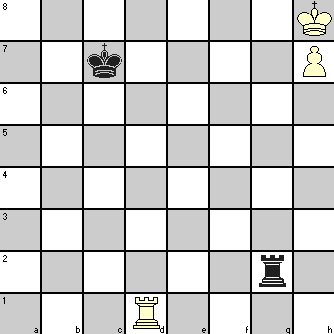
We first see an endgame problem that, though a very simple one, teaches you what zugzwang is and was created by French composer Henri Rinck (1870-1952) who was arguably the World’s Greatest Composer of chess problems.

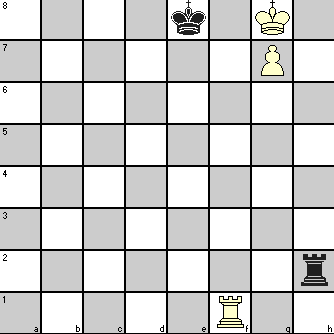
a simple zugzwang

White has to play and win in the position shown. The moves are:

1. Rc7+ Rd7  
2. Qc5+ Kd8   2. … Ke6 3. Qf5+ loses the Rook
3. Kh6  


Black has the move and he is in zugzwang as any move makes him lose. Let us see what some of his options are:

King moves:
3. … Ke8 4. Qe5+ Kf7 5. Rxd7+ Kf8 (or Kg8) 6. Qxb8#

Rook moves:
3. … Rxc7 4. Qf8+ Kd7 5. Qxb8 wins.
If Black’s Rook leaves his second rank without any check, White will play 4. Qe7#

Queen moves:
3. … Qxc7 4. Qf8#.

Black Queen cannot deliver any viable check and trying to remain in contact with c8 square only enables its capture by White. If it loses contact with c8 square, White plays 4. Rc8#.

There are many other options available to Black and we have left it to you to find how the correct move (very important) by White in all the situations result in his winning the Black Rook or Queen or both, or delivering checkmate to the King.

You will notice that putting opponent in zugzwang is preceded by an idle (sometimes blocking) move by the attacker that forces the defender’s hand. In above example, 3. Kh6 was such a move.

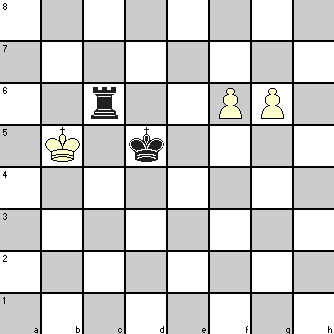
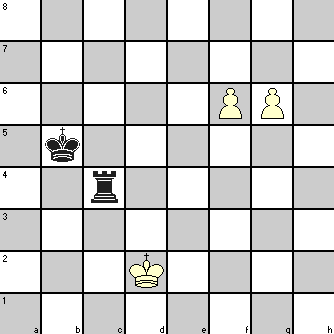
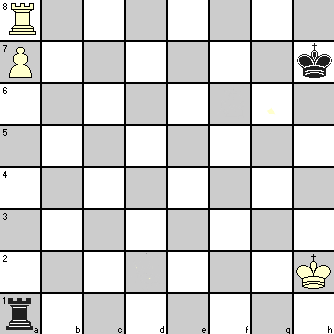
Now that you have seen a simple one, here is another problem which is slightly more complex. This is a very old problem but quite instructive as similar position may arise in one of your endgames also. White is to play and win.

a little more complex zugzwang

With two isolated pawns against three connected pawns, White may appear to be at a disadvantage but White’s winning line is as follows:

1. a6 Kb8   Black King had to move to prevent 2. c7
 
2. Kg1 f3   The idle move Kg1 to wait and watch is the only move that wins for White by creating zugzwang on Black
 
3. Kf2   White’s strategy is simple: move the King to face whichever Black Pawn has advanced. Once that Pawn gets blocked, Black has to move another Pawn. In the meanwhile, Black King cannot move either way without allowing the other White Pawn to promote! You may try with other Pawn moves to verify the tactics.
3. h3  
4. Kg3 h2  
5. Kxh2 f2  
6. Kg2 g3  
7. Kf1  
7. g2+  
8. Kxf2 g1=Q+  
9. Kxg1 Kc7   With no more pawn to move, Black King is forced to take the move it was trying to avoid.
10. a7 Kxc6  
11. a8=Q+   White wins.


Because of its unusual nature, it is a popular theme for chess compositions and Susan Polgar’s blog of July 1 has a problem on this topic.

In Chess Tactics: Some more applications of Zugzwang, you will see a third problem and a game where this tactics was used.


Chess Endgame Tactics: Rook and Pawn endings – Part 4

0
Filed under Chess Tutorials, Chess lessons, Chess tactics, Endgame Tactics
Tagged as ,

You have already seen the established chess tactics for a well-known Rook and Pawn ending called Lucena Position. Here we discuss about Philidor position, another equally well-known chess ending with Rook and Pawn that gives a draw to the defending player if he plays actively and with precision.

Philidor position in Rook and Pawn ending

The requirements for this position are:

  • The pawn of the attacking side and its King have not crossed their 5th rank. The King is in contact with the Pawn
  • The defendant King is on the promotion square or on a square adjacent to it
  • The defendant Rook is on the 6th rank (its own 3rd rank) preventing the enemy King from going forward

The Pawn may be on any file. But as you know from earlier discussions on Rook and Pawn endings, Pawn on Rook file makes the defending King’s job easier.

The position of the Rook of the attacking side (the side having the Pawn) is not directly relevant except for its ability to come to the help of the King and Pawn when necessary. But it is in the interest of the attacking side not to allow the defending King to come forward and create complications. The Rook positioned on the 7th rank keeps the defending King confined to its base rank.

However, check by the attacking Rook does not help in any way as the defending King keeps shuttling between the queening square and the square in front.

The defending side’s strategy:

So long as the Pawn does not move to its 6th rank, the defendant Rook keeps shuttling on that rank (which is its 3rd rank). If the Pawn moves to the 6th rank, the defendant Rook should go to its 7th or 8th rank and keep giving check from behind. There is no respite from check as the attacking King cannot take shelter behind the Pawn.

If the attacking side’s Rook tries to interpose, the defendant should exchange the Rooks. Since defendant King is already in front of the Pawn, all it has to do is to maintain opposition to enemy King, and the ending is a draw.

You can see that if the defending side plays passively and allows the enemy King to get to the square in front of its Pawn and the defending Rook is unable to deliver check, it will be a win for the attacking side. So the defending player has to remain alert if he has to get a drawn game.

A possible sequence of moves in the diagram position is shown below.

Without exchange of Rook:

1. Rg7 Rb6  
2. Rh7 Rg6  
3. d6 Rg1   As the White Pawn has advanced, White K cannot any more take shelter behind the Pawn, so it is safe to move the Black R. If it were done earlier, White would have played Kd6 with a win.
4. Ke6 Re1+  
5. Kd5 Rd1+  
6. Ke5 Re1+  
7. Kd4 Rd1+  
8. Ke5 Re1+   and so on without any headway


With exchange of Rook:

1. Rg7 Rb6  
2. Rh7 Rg6  
3. Rf7 Rb6  
4. Rf6 Rxf6   If Black avoids exchange, White K gets access to d6
5. Kxf6 Kd7  
6. Ke5 Ke7   Black must retain opposition to prevent White King’s access to d6
7. Kd4 Kd8  
8. Kc5 Kc7  
9. d6+ Kd8  
10. Kc6 Kc8  
11. d7+ Kd8  
12. Kd6   drawn due stalemate


Chess Endgame Tactics: Handling Rook and Pawn endings

0
Filed under Chess Basics, Chess lessons, Chess tactics, Endgame Tactics
Tagged as ,

We have discussed at length about basic chess endings with Rook and Pawn as also some special techniques for handling a few typical situations. We also said that with Rooks present, a majority of one or two pawns often do not yield much benefit and such chess endgames are more likely to result in a draw, especially if the pawns are on the same side with their Kings close at hand.

But that is only a general observation. In this article we go through the lengthy process of playing through such a situation where White thought that exact play could give him a win with his single pawn majority if he could get a passed and protected KP.
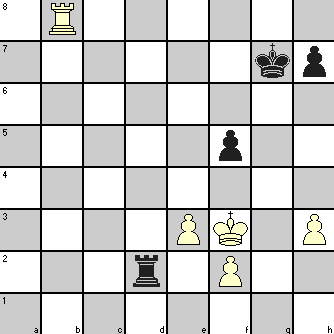
Rook and Pawn ending with multiple pawns

At first sight, there does not seem to be much prospect of a win for White, so let us see what exactly was in his mind! We can of course see that White King cannot advance now without losing the BP.

1. Rb6 Ra2   White’s move blocked Black King’s support to his KBP.
 
2. Rd6 Rb2   Black is shuttling his Rook on rank 2 as ‘wait and watch’ policy while preventing White King from moving forward
 
3. Kg2 Ra2   3. Kg3 f4+ 4. Kxf4 Rxf2+ loses a pawn for White or 3. Kg3 f4+ 4. exf4 doubles the pawns effectively giving White BP and RP against Black’s RP which is a technical draw
4. h4 Ra4  
5. Rd4 Ra6   Other options are worse for Black e.g.,
5. … Ra2 6. Kg3 Kf6 7. Rb4 Ke5 8. Rb7 f4+ 9. Kf3
or
5. … Ra2 6. Kg3 Re2 7. Rb4 Kf6 8. Rb6+ Kf7 9. h5 Kg7 10. Rb7+ Kh6 11. Rf7 Kg5 12. f4+ Kh6 13. Kf3 wins as Black K is out of position and both Black R and BP are en prise
6. Kg3 Kf6  
7. Kf4 h6  
8. h5 Rb6  
9. f3 Ra6   Black R cannot leave rank 6 for fear of check by White R
10. Rb4 Rc6  
11. Rb7 Rc4+   White was threatening 12. Rh7 followed by 13. Rxh6
12. e4 fxe4  
13. fxe4 Rc5   Whie has got his passed KP. Black could possibly try Rc1 here instead of waiting till move 16
14. Rb6+ Kg7  
15. Rg6+ Kh7   Black’s only move to save his RP. If White had a passed KBP rather than KP, Black could have saved the game.
16. e5 Rc1  
17. e6 Rh1  
18. Rg3 Rh4+   18. … Rxh5 19. e7 wins for White
18. … Re1 19. Re3 Rf1+ 20. Ke5 Rf8 21. e7 Re8 22. Ke6 Kg1 23. Kd7 Kf7 24. Rf3+ followed by 25. Kxe8
19. Rg4 Rh1  
20. Kf5 Rxh5+  
21. Kf6 Rh1  
22. e7 Re1   22. … Rf1+ 23. Ke5 Re1+ 24. Re4
23. Rg7+ Kh8  
24. Rf7 Rf1+  
25. Kg6   Black is helpless.
25. … Rg1+ 26. Kh5 Rg8 27. Rf8 Kg7 28. Rxg8+ Kxg8 29. e8=Q+
Alternatively, Black R can continue giving check while the White K keep moving in zig-zag fashion between g-file and h-file till it reaches rank 2 (g6-h5-g4-h3-g2) after which Black runs out of check and White KP gets promoted.