Tag Archives: endgame tips

7 endgame positions with endgame tactics for quick checkmate-part 1

3
Filed under Endgame Tactics
Tagged as , , ,

On a journey, if you have clear idea about where you are going, you can choose the shortest way to reach your destination. If the planned route gets blocked somewhere, you will take a detour to come back to your route or to get to the destination without wandering aimlessly.

Same way, if you know that you have enough material for creating checkmate as explained in Ten endgame tactics, you should also know what chessboard position you must create for a checkmate with the pieces at your disposal.

In this article, we are showing the typical positions you have to reach for final attack on the opponent’s King which is presumed to be alone.

As pointed out in Ten endgame tactics, the enemy King has to be at the edge or a corner square of the chessboard depending on the pieces you have for that final check. So we have set the opponent’s King near the center of the chessboard to show how it can be pushed where you want it to be. In every diagram, White is presumed to move first.

1. When you have Queen and Rook – situation A

fig9

                              	1. Qe4+		Kd6
                               	2. Rc6+		Kd7
                              	3. Qe6+		Kd8
                              	4. Rc8#


2. When you have Queen and Rook – situation B

fig10

                        	1. Qh5+		Ke6
                        	2. Rg6+		Kf7
                        	3. Qh7+		Kf8
                        	4. Rg8#


3. When you have the Rook pair

Here it is like the above, but some additional moves may be necessary if the enemy King tries to capture one of the Rooks by approaching it diagonally.

fig11

                        	1. Re1		Kd4
                        	2. Rd2+		Kc3
                        	3. Rd8		Kc2
                         	4. Re7		Kb3
                          	5. Rc7		Ka4
                          	6. Rb8		Ka5
                         	7. Ra7#


4. When you have the Queen

Here you have to position your Queen in such a way that area of the chessboard available to the enemy King continues to get reduced and then move your King towards the enemy King. The checkmate can be delivered in two ways:

a. With the opponent’s King at the edge of the chessboard, Queen supported by your King delivers check by closing in.

b. With your King getting the ‘opposition’, Queen delivers check along the edge row or file where enemy King is standing.

fig12

                        	1. Qe3		Kd6
                        	2. Qe4		Kc5
                         	3. Kf2		        Kd6
                              	4. Ke3		Kc5
                             	5. Qd4+		Kc6
                        	6. Ke4		Kb5
                        	7. Kd5		Ka6
                              	8. Qb4		Ka7
                        	9. Kc6		Ka6
                              	10.Qb6# (type a above) or 10.Qa4# (type b above)


You have to be on the alert that a stalemate does not arise. For example, with Black King at a8, if you moved your Queen to b6, Black King cannot move anywhere and Black will claim stalemate and draw!

5. When you have the Rook

With a Rook, a supported checkmate like 4a is not possible, it has to be like 4b. Here also, your aim will be to place rook in the row or file next to that where Black King is standing, but of course out of reach of the enemy King. You have to select the Rook’s position that will leave least space to that King. In between Rook’s moves, you have to close in with your King. When the Rook gives check, your King will be guarding the Black King’s escape squares in diagonal or perpendicular direction relative to line of check.

fig13

                           	1. Rf6		        Ke5
                        	2. Ra6		Kd5
                             	3. Kf2		        Kc5
                        	4. Ke3		Kb5
                             	5. Rd6		Kc5
                        	6. Rd4		Kb5
                             	7. Kd3		Kc5
                              	8. Kc3		Kb5
                               	9. Rc4		Kb6
                              	10.Kb4		Kb7
                               	11.Kb5		Ka7
                         	12.Kc6		Kb8
                        	13.Ra4	 	Kc8
                               	14.Ra8#


Note: The position reached after move 12 is a typical situation and White’s Rook move forces Black King to get into opposition and checkmate. This tactics can be applied with Black King anywhere on the back row and White’s King positioned in the 6th row of adjacent file.

In Endgame tactics Part 2, we will examine the other positions involving the minor pieces.

10 endgame tactics you should remember to decide a win or draw

6
Filed under Endgame Tactics
Tagged as , , ,

We have earlier shown two endgame positions which exemplified the use of some endgame tactics. In Four endgame situations also, we explained some typical endgame tactics like the concept of ‘the Square’ and the ‘Opposition’. Here are some more that will help you to decide quickly the possible result of the chess game. If you know what endgame situations will work against you or go in your favor, you can start planning your strategy much earlier keeping these positions in perspective for carving a win or snatching a draw depending on situations.

In the following chess tactics, it is presumed that the opponent is left with a solitary King.

1. It is not possible to checkmate the enemy King if you are left with:

  • single Knight
  • single Bishop
  • Knight pair

2. Your King’s support is essential to checkmate opponent’s King with the following:

  • Queen
  • Rook
  • Bishop pair
  • Bishop and Knight

3. King’s help is not needed for checkmate by these combinations:

  • Queen and Rook
  • Rook pair

4. The enemy King has to be pushed into a corner (literally!) to deliver checkmate by:

  • Bishop pair
  • Bishop and Knight

5. The enemy King has to be forced to the edge (row or file) of the chessboard for checkmate by:

  • Queen and Rook
  • Queen
  • Rook pair
  • Rook

6. Memorizing the chess tactics to deliver checkmate in the least number of moves is important (topic for a separate article). Otherwise, even with enough material, you may have to agree to a draw because of the chess game rule which stipulates that checkmate must be achieved within 50 moves from the last pawn move or piece capture.

7. In consideration of above restriction, you have to examine what moves on your part will progressively reduce the chessboard area accessible to enemy King for delivering checkmate as quickly as possible.

For example, if enemy King is on d7 square, a Rook placed on the sixth row will restrict the movement of enemy King to rows 7 and 8 only. If it were at b4, your Rook should be placed in c-file to confine the opponent’s King to a-file and b-file. You get the idea? The same principle will apply when you are using a Bishop pair to ‘corner’ the enemy King.

8. If you are left with a single bishop or a knight pair against enemy pawns, the best you can hope for is a draw by using your King and piece(s) to eliminate opponent’s pawns or to keep them blocked.

9. Gaining ‘Opposition’ by your King is an important part of your tactics for pushing the enemy King to a corner or edge.

10. A defensive tactics to convert a losing position to a draw is creating stalemate situation, when the enemy king is not under check but cannot make the next move without getting under a check. Be aware of this possibility as all it requires is a wrong move on your part.


When you really need to think deep in chess?

2
Filed under Chess Tutorials
Tagged as , , ,

In an earlier article, I pointed out that in the middle games, you cannot possibly visualize all the positions that can emanate from your next 4-5 moves without having a computer-like memory. Most likely, you will decide on the next move based on your reading of the overall position.

But in the endgame, with few pieces standing on the board, it is possible to make a deeper analysis and this often makes the difference between a win and a draw or loss. But it is easier said than done, as even experienced players sometimes fail to see the right moves available as it is, or fail to identify a bad move from the opponent that could be exploited.

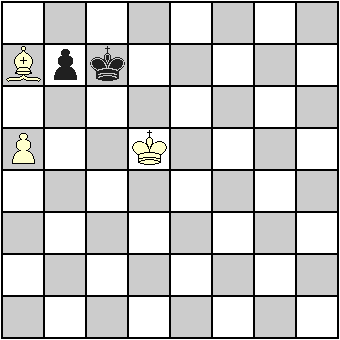
The following two examples will make the point clear and establish the importance of studying endgame tactics. You should also see the 4 endgame tactics given before as some of those themes occur in the following examples also.
endgame2

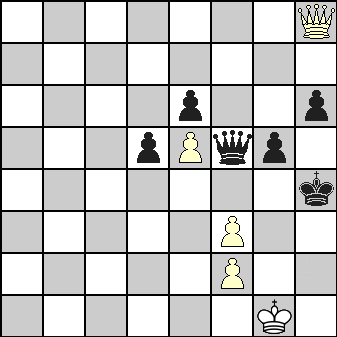
In the position shown, Black seems to have the advantage because of an extra pawn plus the poor pawn structure of White due to doubled pawns. In this position, Black played h5 which was a bad move as it deprives black king of one of the two escape squares at h3 and h5. But White could not utilize this opportunity and ended up a loser.

How could White turn the table after Black’s move? Here is the possible sequence:

1. h5  
2. Qf6 Qh3  


You can see that Black cannot afford to exchange Queens on f5 or f6 square as after that, White’s KP cannot be stopped from ‘queening’.

Even retreat to f4 square does not help as White’s Queen will capture Black’s KP, thus freeing his own KP to advance. Advancing NP by Black to create a counterplay also fails as it allows check by White Queen along d8-h4 diagonal forcing exchange of Queens. In the race for ‘queening’, White KP gets it one move before Black’s QP does and White gets the chance to finish off the game before Black’s promoted Queen can move!

3. Qf7 d4  
4. Qf8 d3  


White is maneuvering to force Black to advance the pawn so that he can strike at the right moment.

5. Qb4+ g4  
6. Qe7#  


endgame1

In this position, White has a Bishop and Pawn against Black’s single Pawn. But the Bishop has no control on white squares, so it cannot capture Black’s pawn. So long as black King is hovering around the pawn, White’s King cannot get near the black pawn to capture it. White’s pawn cannot advance past Black’s pawn without getting captured and a King and Bishop are inadequate to deliver a mating attack. Even if White Pawn could proceed to “queening” square (a8), the bishop will not be able to support it. On the other hand, Black also cannot advance the Pawn without handing over the game to White. It looks like an impasse, doesn’t it? So your conclusion will be the same as that of the actual players who agreed to a draw. But is a draw inevitable?

You know what strategy Black has to follow. So, to prevail upon Black, your strategy should be to push the Black King away from the 3×3 square (a8-c8-a6-c6) through Bishop checks. At the same time, your White King should try to gain the opposition to prevent Black King from reentering this square. Black in turn will try to use opposition to block White King’s approach or to take refuge at a8 square. So White has to follow some precise steps as follows.

1. Kd4 Kc6   If White K moves to c5 or c4, Black delivers check by advancing pawn and White has to capture it. Black then proceeds to a8 square to create a stalemate situation.
 
Black in turn cannot advance his pawn or move K to d-file without giving the initiative to White
 
2. Bb6 Kd6   If Black goes to b5, White King can occupy d5 preventing Black King from going back to save his pawn
3. Kc4 Kc6  
4. Kb4 Kd6  
5. Kb5 Kd7  
6. Kc5 Kc8   Other moves of Black King will allow White Bc7 and then Kb6 to keep Black King at bay
7. Ba7 Kc7  
8. Kb5 Kd7  
9. Bb8 Kc8  
10. Bh2 Kd7
(or Kd8)
 
11. Kb6   and White wins as he will soon capture Black’s pawn and promote his pawn unhindered