Tag Archives: endgame tips

How to checkmate using King and Queen vs. King

6
Filed under Chess Tutorials
Tagged as chess endgame, chess endgame tactics, chess endgame tips, Endgame Tactics, endgame tips, endgame tutorial, king and queen vs king, queen vs king

end-game

A checkmate can be enforced with the following minimum materials:

  • King and Queen versus King
  • King and Rook versus King
  • King and Two bishops versus King
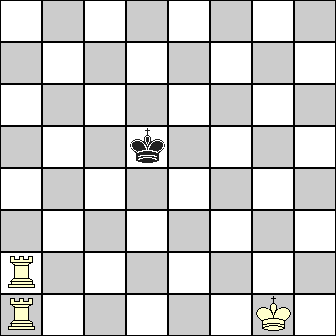
  • King and Two rooks versus King

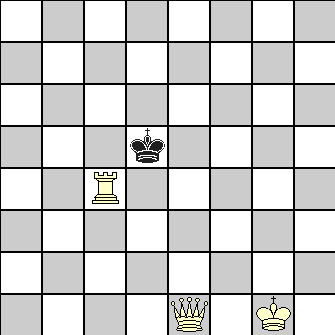
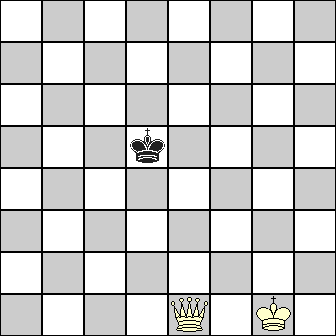
In this article, let us discuss the ways in which the opponent King can be checkmated using only the King and Queen at your disposal.

The King, as we know, can move only one square either on any of the sides, front, back or on either of the two sides. The Queen can move any number of unoccupied squares in a rank or file and in any direction.

The first thing that needs to be done is to restrict the movement of the opponent king either to only one rank or only one file among ranks and files in the chess board – that is – either to the first rank or to the eight rank horizontally or to the “a” file or the “h” file vertically. This can be done using the Queen.

Suppose the King is in “g4”, then placing the Queen in the “f” file will restrict the movement of the king to only among the “g” and “h” files. Then the next step would be to make the opponent move to the “h” file and then block the “g” file. Once the king is made to move only among the ranks in the “h” file by placing Queen in the “g” file, then the King should be made to move to the “f” file.

Using the King and the Queen might be tricky at times, and any urgency shown by you in hastening the things might result in a stalemate, instead of a checkmate, and you may have to settle for a draw where you had every chance to finish the game in your favor. You are aware that a stalemate results when the opponent king, in his turn to make the movement, on not being attacked with a check, has no legal moves to make. One typical case of a stalemate is a position in which the opponent king is “a8”, your king is in “a6” and your Queen is in “b6” and it is the turn of your opponent to make a move. The opponent king cannot move and you are not attacking the king either. This is the case of a stalemate.

To avoid a stalemate, it is important that sufficient distance is maintained between the Queen and the opponent King in the “g” file. After ensuring that there is enough distance, then the King should be made to move in the “f” file nearer to the rank of the opponent King in the “h” file. Suppose the opponent king is “h6”, and your Queen is “g1”, then your King should be made to move either to “f7” or to “f5”, and in the next move in your turn, you can place the Queen at “g6” or “g5” and call it “Check”. The opponent King will have no place to move and has to succumb to a defeat.

The similar positioning using the ranks can also be attempted and practised to win the game using only the King and Queen against the opponent’s King.
How to checkmate using King and Rook vs. King

0
Filed under Endgame Tactics
Tagged as chess endgame, chess endgame tactics, chess endgame tips, Endgame Tactics, endgame tips, endgame tutorial, king and rook vs king, rook vs king

end-game

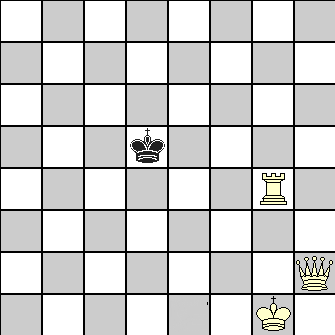
In this article, let us discuss the ways in which the opponent King can be checkmated using only the King and Rook at your disposal.

The King, as we know, can move only one square either on any of the sides, front, back or on either of the two sides. The rook, on the other hand, is capable of moving any number unoccupied squares either horizontally or vertically, and it cannot move diagonally.

A King and a Rook can always checkmate a lone King of the opponent. For this to happen, both the King and the Rook should work together such that the opponent King is driven to the edge of the board. This can be successfully achieved by cutting of the squares in which the King can effectively move, so that the opponent King has fewer options and finally is forced to move to the corner of the board, such as either “a8”, “a1”, “h8” or “h1”.

Unlike the Queen, the capability of the rook is limited, and the opponent can try to attack the rook and drive away the rook in order to gain more squares to move on. The opponent King can, however, only try to delay the inevitable as it can move only one square at a time. Nevertheless, using the king and the rook might be very tricky as well. The King has a very important role to play as well in this attempt.

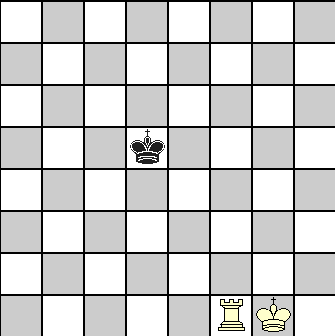
To make the point more clear, let us assume the positions in a chessboard as follows: The opponent King is in “d6”; your king is in “d3” and your rook is in “a1”.

If it is your turn to move, it would be foolish to attack the opponent King by calling check at “a6”. If you do so, the opponent king might move to the centre of the board by moving one rank to “e5”. As your mission in this case would be to drive the king to the nearest corner, which is a8, you can place the rook at “a5” thus restricting the movement of the opponent King to only ranks 6, 7 and 8. As the rook can move only horizontally or vertically and cannot move diagonally, the opponent king might try to attack the rook and move it to “c6”. Your next move in that case should be to move the king to “c4”. The opponent King, in an attempt to drive away the rook, might move to “b6” threatening your rook in “a5”.

Here, you should be careful. You may be tempted to call check by placing the rook at “b5”. If you do, the opponent might move to “c6” and your attempt to pin down the opponent King at “a8” might get delayed. Therefore, it would be wise to move the rook to “c5” and restrict the movement of the opponent King to only the three ranks in two files “a” and “b”. Now, the opponent King has to make the movement only in those six squares and ensuring that no escape route is allowed to the opponent king, the ranks can be closed in such a way that the opponent king is pushed to the corner “a8” and your king is placed at “b6”. Ensuring this, a check by rook at “c8” will be the killer blow and results in a checkmate.

7 endgame positions with endgame tactics for quick checkmate-part 2

1
Filed under Endgame Tactics
Tagged as chess endgame, endgam tactics, endgame strategy, endgame tips

In Endgame tactics Part 1 of this two part article, we discussed the chess tactics for checkmate with the ‘heavy’ pieces viz., Queen, Rook or a combination of those pieces. Now we will consider the more difficult tasks of creating checkmate with a Bishop pair or a Bishop and Knight.

6. When you have a Bishop pair

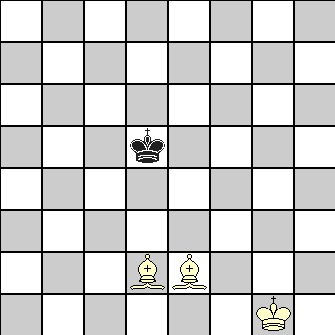
fig14

                               	1. Kf2      Ke5
                               	2. Kf3      Kd5
                              	3. Bc3      Kc5
                         	4. Ke4      Kd6
                              	5. Bc4      Kc6
                             	6. Bd4      Kd6
                             	7. Bd5      Kc7
                              	8. Bc5      Kd7
                          	9. Ke5      Kc7
                        	10.Ke6      Kd8
                           	11.Bb6+     Ke8
                               	12.Bc6+     Kf8
                               	13.Kf6      Kg8
                           	14.Bc5      Kh7
                            	15.Bf8      Kg8
                         	16.Bg7      Kh7
                                17.Be4+     Kg8
                        	18.Bh6      Kh8
                               	19.Kg6      Kg8
                           	20.Bd5+     Kh8
                            	21.Bg7#


You should note that a wrong step could lead to stalemate and draw.

The point you should realize is that the two bishops side by side on a row or file create a double V forcing the enemy King to remain within the wedge-shaped area. The bishops moves should push the V towards the edge to force the Black King to move there. While repositioning Bishops, your own King has to guard against the Black King escaping out of the wedge.

7. When you have a Bishop and Knight

A Bishop and Knight can be used to deliver the checkmate only when the Black King can be pushed into a corner square that is accessible to your Bishop. So, if you have KB (which controls white squares), black King has to be driven to a8 or h1 squares. If it is QB, checkmate will be possible when the black King is in a1 or h8 square. Your game plan has to take this into consideration, otherwise you will be wasting moves.

Depending on the final position reached, the checkmate may be by a Bishop check or a Knight check.

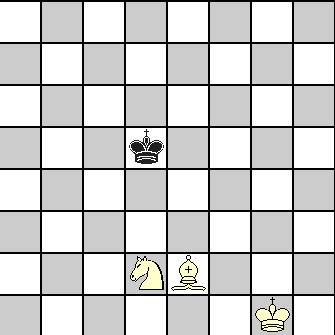
Assuming that your KB is on board, the white squares will be guarded by the Bishop and the black squares by the Knight (or Knight in tandem with King).

Black’s tactics in the above situation will be to avoid going towards a8 or h1 square, so White should guard against this plan of Black.

fig15

                              	1. Kf2 	Kd4	21.Bd3	Kf2
                        	2. Nf3+	Kd5	22.Bc4	Kg2
                             	3. Ke3	Ke6	23.Ne5	Kh3
                        	4. Ke4	Kf6	24.Ng6	Kg2
                           	5. Bc4	Kg7	25.Ke3	Kg3
                             	6. Kf5  Kh8	26.Be6	Kh2
                              	7. Ng5  Kg7	27.Kf3	Kg1
                             	8. Ne6+	Kh6	28.Bh3	Kh2
                             	9. Kf6  Kh7	29.Nf4	Kg1
                              	10.Bd3+	Kh6	30.Bg2	Kh2
                        	11.Ng5	Kh5	31.Nh5	Kg1
                             	12.Nf7	Kg4	32.Ng3	Kh2
                             	13.Ke5	Kh5	33.Bf1	Kg1
                              	14.Bf5	Kh4	34.Bg2	Kh2
                             	15.Kf4	Kh5	35.Nf1+	Kg1
                             	16.Be4	Kh4	36.Bh3	Kh1
                            	17.Bg6	Kh3	37.Kg3	Kg1
                              	18.Ng5+	Kh4	38.Nd2	Kh1
                             	19.Nf3+	Kh3	39.Bg2+	Kg1
                                20.Bf5+	Kg2	40.Nf3#


There are more than half a dozen ways in which the final check would be possible through the Knight or the Bishop. If you understand the general principle of the tactics, you can find your way to win.

The best way to get familiar with the tactics is to play with your chess-playing friend from a set-up position, telling him the tactics you are going to adopt and your friend should try his best to delay the checkmate. Keep a count and record of the moves and see how quickly you can reach your target. With practice, these types of tactics will soon become a part of your arsenal.