Tag Archives: chess strategies

4 Important Chess Weapons

0
Filed under General Chess
Tagged as , , ,

The goal of any chess game is basically to move your pieces in a strategic move, giving you a chance to finally eliminate your opponents’ king. This chase can take a long time and in the process you will need to know what weapons will help you get rid of his/ her king. With this weapon or methods in mind you can successfully win the game.

A complicated yet sure way is by use of the weapon known as the back rank mate. As you play the game, your opponent will always make sure his King is guarded well. Therefore as you move your pieces, your aim should be to reach a point where you can to get rid of that guard. When your opponent notices that you want to eliminate his kings’ guard he will think of a move to eliminate your piece and keep his King safe. Since you know that this will be his move, you should have a back up idea which should involve getting rid of that same piece used against yours. The only thing he will do is to surrender to your checkmate declaration.

Pin and fork is another weapon that can be used to give you a win in chess. This method requires you to corner two of your opponents’ pieces at the same time. Therefore you will have to carefully analyze each of your opponents’ moves to be able to place him in a fix without him realizing. Since chess players are always alert, this can be challenging for beginners. When using this weapon, every move you make should be spontaneous while keeping in mind that when an opening arises do not hesitate to declare check.

Skewer is a word often associated with barbeque on a stick. In chess it means that there is a line of important pieces and you can easily trap them all. Play the game in a way that will force your opponent to position his king ahead of his queen. In this way you will say check and you opponent will do everything to get his king out of harm’s way forgetting that the queen in right behind in the line of attack.

Turning away also known as deflection is another great chess weapon. As you play the game your opponent will have a guard for every important piece like the King. Since you are aware of this, you should play your game in a way that will force your opponents guard to move or deflect away from that protective position. This will leave the king susceptible to any attack you that make and give you a better chance of winning the game.

Mastering deflection, skewer, pin and fork or bank rank mate does not take one game. you will have to practice this over many games to come out as an expert. This is because cornering your opponents’ piece is not easy to do without him aware. Therefore just like any game put these weapons to practice.

Ideal cocktail punch in chess games: mixing chess strategy with chess tactics in correct proportion

2
Filed under Chess Tutorials
Tagged as , , ,

In the article on Capablanca’s chess games, you have seen the apparent simplicity of his chess play built on good chess strategies . In the present article, you will see another chess game played by him that shows a beautiful example of mingling chess strategy with chess tactics. Capablanca was playing as White against Charles Jaffe (1874-1941) in a 1910 tournament in New York.

1. d4 d5  
2. Nf3 Nf6  
3. e3 c6  
4. c4 e6  
5. Nc3 Nbd7  
6. Bd3 Bd6  
7. 0-0 0-0  


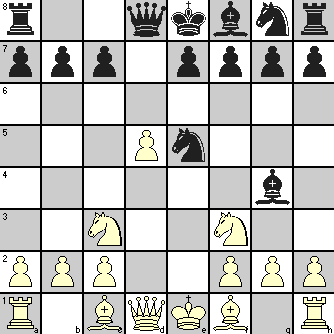
The following shows the position after both players have castled.

fig7

The position looks equal and near symmetrical, but I would think that White has a slight advantage because he has a more fluid position with greater space. (Were these two factors included in your chess strategies?) Most of his pieces appear ready to join in the fray whereas Black’s QB is still hemmed in. Capablanca now tries to take control in the center (chess strategy again).

Black of course realized the danger and started exchanges to thwart White from establishing his control. White switched to exerting pressure on h7. To prevent White KN to advance for attacking his King’s position, Black was obliged to advance the RP to h6, but as you know now from your chess strategies, this creates a weakness in Black’s castled position.

Do you also remember your chess strategies to identify the key defender for Black? Obviously the knight. But with White’s QB at b2, all White needed was to advance his QP to attack that defender, elimination of which would seriously jeopardize Black King’s position. Black had to consider that possibility When the White Queen joined the KB along b1-h2 diagonal, and thus advanced his KNP in an attempt to block that diagonal, at the cost of further weakness in his castle.

White immediately took control of the semi-open e-file by his rook (chess strategy again)! See how smoothly White keeps targeting different areas of Black’s Kingside and forcing him to weaken his position step-by-step. In order to open his Queen’s line and to create a counter pressure on White Q, Black started his knight maneuver to h5 with eye on f4. To still keep the knight in gun-sight if it came to f4, White took his QB to c1, simultaneously attacking the weak KRP. White is giving us a chess lesson on how to build up pressure one after another. It was putting Black so much on the defensive that Black was not able to work out any counter-attack!

As a desperate measure to tackle the threats, Black king then moved to g7 to keep his KR ready to occupy h8. Just see how quickly in a span of 9 moves, Black’s position was falling apart from a situation of near equality! Play through the moves 8-16 to see how all these happened.

8. e4 dxe4  
9. Nxe4 Nxe4  
10. Bxe4 Nf6  
11. Bc2 h6  
12. b3 b6  
13. Bb2 Bb7  
14. Qd3 g6  
15. Rae1 Nh5  
16. Bc1 Kg7  

&nbap;

After 16 moves, the position is shown below.

fig8

With all his pieces appropriately mobilized and set to attack Black’s King position, White now swoops down like a hawk by his move 17. Rxe6! Did you see this move? The rook is of course taboo because if 17. … fxe6, White forces mate by 18. Qxg6+ and then 19. Qh7+. But the text move helped only to delay the inevitable. Black also tried desperately to open his QB diagonal along a8-h1 to bring QB to e4. All he needed was one move but White was not giving him that chance!

17. Rxe6! Nf6  
18. Ne5 c5   For 18. … Rh8, refer Option A below
 
19. Bxh6+! Kxh6   For 19. … Qd7, refer Option B below
20. Nxf7+ Resigns  


Option A:

18. Rh8  
19. Nxf7 Kxf7  
20. Qxg6+ Kxe6  
21. Bf5+ Ke7  
22. Re1+ Kf8  
23. Bxh6+ Rxh6  
24. Qxh6+ Kf7  
25. Be6+ Ke7  
26. Qg7+ Ke8  
27. Qf7#  


Option B:

19. Qd7  
20. Qxg6+ Kf8  
21. Bxh6+ Rxh6  
22. Qxh6+ Kxf7  
23. Rxf6+ Ke8  
24. Re1+ Kd8  
25. Rxd6 Qxd6  
26. Qxd6+ Kc8  
27. Re8#  


Didn’t this chess game look to be flowing on its own? Could a computer’s chess play improve on this one?

P.S. Jaffe had his revenge three years later when playing as Black, he defeated Capablanca in a tactical game in a New York tournament!


Elements of Chess and their importance Part 2

1
Filed under Chess Basics
Tagged as , , ,

You can read Elements of Chess Part 1 here

elements_of_chess1

You may recall that each player is provided with 16 pieces at the beginning of the game. The sixteen pieces are as follows:

  • One King
  • One Queen
  • Two Bishops – one in white and one in black
  • Two Knights
  • Two Rooks
  • Eight pawns

Before going further, I would like to state that not all chess pieces are created to be equal. Some pieces are more valuable than the other pieces and these pieces gain their importance or strength depending upon their mobility. Except the King, which is of infinite importance, all the other pieces have been assigned some value depending upon their significance and mobility.

Let me now explain each of these pieces, their scope of movement in the chessboard, their value in the chessboard and their notation in chess parlance.

kings
King

The King is the supreme power in the game of chess and the mission of the game in chess is to capture the king of the opposite player and vice versa. The King is the slowest moving piece, even slower than the pawns, but the most valuable one in that if King is lost, then the game is over. As the king is the important piece in the game and the capture of the king ends the game, there is no point assigning a special value to the King to signify the importance of that piece. Hence, the King has no specific value to assign. All other pieces have some value depending upon their importance and capability of movement

In the chessboard, the white king is placed in the “first” rank of “e” file – that is “e1”. Similarly, the black king is placed at the “eighth” rank of “e” file – that is “e8”. You may notice that the white king is at the black square and the black king is at the white square.

In chess parlance, the King is assigned the capital letter “K”. You know that the white king is placed at “e1”. If you move the King one step forward to the second rank, it will be denoted as “Ke2” – indicating that the King has moved from the existing position to “e2”.

The King can move only one square in any direction. It cannot move more than one square in any direction in the normal course of the game. There is only one exception to this rule. When a player resorts to Castling, which I will explain to you a little later, the king is allowed to move either two spaces to the left or three spaces to the right depending on the side on which castling is resorted to by the player.

queens

Queen

The most powerful piece in the chessboard is the Queen. The Queen has been assigned a value of 9, the highest value for any piece in the chessboard. Since Queen is the most important piece other than the King, it has more capabilities that other pieces and as such needs to be handled very carefully. Losing the queen will not result in the loss of game as such, but the capabilities to attack as well as defend in case of counter-attack will be greatly reduced if you lose the queen in the course of the game.

Before knowing about the movements of the game, let me explain to you where it should be placed in the chessboard at the time of starting the game.

The Queen is placed adjacent to the King on the left hand side. The white Queen, as such, will be placed at the “first” rank of file “d” – that is “d1”. The black Queen will be placed at the “eighth” rank of file “d” – that is “d8”. The White queen is placed in the white square and the black queen is placed at the black square.

The queen is one piece in the chessboard that can move in any number of unoccupied squares vertically, horizontally or diagonally. None of the pieces, except the Knight, can jump on top of the other pieces. They can move only on unoccupied squares. The queen, starting from “d1” can move either horizontally to “a1” or “h1”, move vertically up to “d8” or move diagonally to “c2”, “b3”, or “a4” on the left hand side or to “e2”, “f3”, “g4”, and “h5” on the right hand side, provided there are no pieces on any of these squares.

In chess notation, the queen is assigned capital letter Q. For example, if queen moves from “d1” to say “g4” diagonally, then it is represented as Qg4.

rooks

Rook

The second important piece in the chess board, next to the king and queen, is the rook. In fact, each player is provided with two rooks. Each rook has been assigned a value of 5, the second highest value for a piece in the chess board.

In the beginning, the two rooks are placed at two corners in the first rank for a player using white pieces and at the two corners of eighth rank for the player using black pieces. In other words, the white rooks are placed at “a1” and “h1” respectively, while the black rooks are placed at “a8” and “h8” respectively.

The rook can move any number of unoccupied squared either vertically or horizontally only. It cannot move diagonally. For example, if the rook is in fourth rank of “d” file, it can vertically move anywhere along the “d” file or horizontally across the fourth rank.

In chess notation, the rook is assigned capital letter R.

bishops

Bishop

The next piece in the game of chess, which is not as important as the Rook or the Queen, is the Bishop. Each player is provided with two Bishops. The specialty of these bishops is that they can move only in that color which is assigned to them at the beginning. As such, they cannot move into the square in the other color. Each bishop is assigned a value of 3, lesser than the value of a rook.

In the beginning, the two bishops are placed adjacent to the King and the Queen, in the first rank and eighth rank for the white and black pieces respectively. You might recall that the White King will occupy the black square and the black king will occupy the white square. As such, for the white pieces, the bishop adjacent to the King will be placed in the white square at “f1”, and for black pieces, the bishop will be placed in the black square adjacent to the King at “f8”. Similarly, for white pieces, the second bishop will be placed to the left of Queen in the black square at “c1”, and for black pieces, the second bishop will be placed in the white square at “c8”.

Now, here comes the specialty of the bishops. The bishops can move any number of unoccupied squares, either forward or backward, only diagonally. They cannot move either horizontally or vertically. For the white pieces, the bishop adjacent to the king in the white square at “f1” can move only in the white diagonals and cannot move in diagonals of the other color. Similarly, the bishop adjacent to the Queen at “c1” can move only through the black diagonals. The same thing applies to the black pieces and the two bishops placed at “c8” and “f8” respectively can move diagonally only in squares of the same color.

In chess notation, the bishop is assigned capital letter B.

knights

Knight

The next piece in the game of chess is the Knight. Each player is provided with two knights. In terms of value, each knight is treated at par with the bishop and as such is assigned a value of 3. Just as the rook and the bishop have special features, the knight also has special features as well.

In the beginning, the two knights are placed in between the rook and the bishop on either side of the King and Queen, which occupy the two centre places in the first and eighth ranks respectively. For a player using white pieces, the two knights are placed respectively at “b1” and “g1” respectively in the first rank, while for the player using black pieces, the knights are placed respectively at “b8” and “g8” respectively at the eighth rank.

The moves of the knight are very peculiar. It can move neither diagonally as do the bishops, nor move horizontally or vertically as can the rooks do. The movement of the knight can be best described as a one-two approach. Either the knight can, in one single move, either move one square horizontally and two squares vertically adjacent to the horizontal square, or move one square vertically and two moves horizontally adjacent to the vertical square. Let me make it clear with an example. We know that one knight is placed at “b1” in the beginning. The first move of Knight can be to “c3” – that is one move vertical, which is “b2”, and two moves horizontal – “c2” and “c3” – the third square being the destination square – that is “c3”. The knight may be also moved to “d2” if there is no piece in “d2”. In this case, the knight moves one move horizontal – that is ”c”, and the next two moves are horizontal – “c2” and “d2”.

For the move to be completed, it is essential that the destination square must be an unoccupied one. The knight is the only piece that can jump over the other pieces that lie in between the original square and the destination square. One more important thing to be noted is that while moving the knight, the color of square is important. If the knight is presently in a white square, it can move only to a black square and cannot move to another white square.

In chess notation, the knight is assigned capital letter N. Some people also refer to the knight as ”Kt”, but I prefer using “N”.

pawns

Pawn

The last of the different types of pieces in the chessboard is the “Pawn”. Eight such pieces are assigned to each player. The player using white pieces must use the second rank, while the player using the black pieces can use the seventh rank, to place the eight pawns given to each of them. Each pawn is assigned a value of 1.

Though pawn is the least powerful piece in the chessboard, it has some unique characteristics. Pawn is the only piece that cannot move backwards. All other pieces can move either forward or backward. The pawn may move either one or two squares forwards on its first turn, but afterwards it can move only one square at a time. Another interesting feature of the pawn is that it captures the opposite side piece in a way different from the way it moves. In other words, the pawn captures enemy pieces only diagonally.

For example, if there is a pawn in e4, it can capture any piece lying at “d5” or “f5” only and cannot capture a piece in “e5”. Hope I have made it clear to you now.

No letter is assigned to the pawns, while recording chess notation. Only the designation of the square, such as e5, d3, is mentioned in the notation. If only the designation is mentioned, we can presume it to be the pawn movement.

Conclusion

Now, we have understood the basic elements of chess and their relative importance.