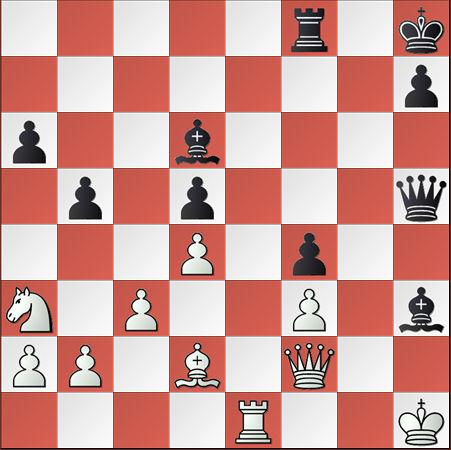
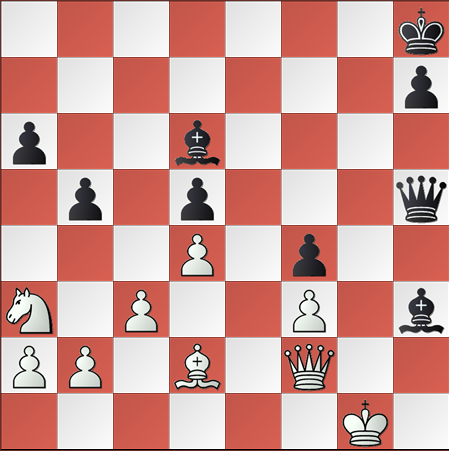
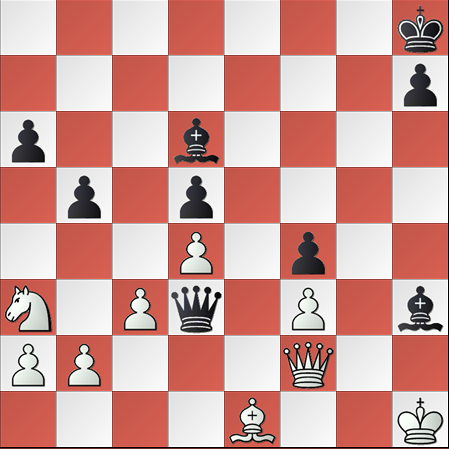
This puzzle was devised by Dr. Karl Fabel and published in 1949 in “T.R.D.’s Diamond Jubilee” issue of the Fairy Chess Review.
WHITE TO PLAY AND MATE IN SIXTY.
Fen Position
For those of you who are interested in analyzing the position with their favorite chess program here is the FEN Position, you can simply copy it and paste it in Chessbase or you could simple save it in a .Fen file and load it as FEN.
8/4K3/4NN2/p3p3/rnp1p3/1pk5/bp1n4/qrb1N3 w – - 0 1
2nd Puzzle
This chess puzzle by C. S. Kipping was published in the Manchester City News in 1911.
WHITE TO PLAY AND MATE IN THREE.
Fen Position
Compared to the last one this is pretty easy but rather baffling how White goes on with the next few moves, by the way this puzzle is for fun.
k7/8/N1N5/3B4/K7/8/4p1r1/8 w – - 0 1
3rd Puzzle
This puzzle was composed by Hans August and Dr. Karl Fabel, and was published in 1949 in Romana de Sah.
WHITE HAS JUST MADE HIS SEVENTEENTH MOVE. WHAT WAS BLACK’S NINTH MOVE, AND WHAT WERE THE MOVES THAT FOLLOWED IT?
Fen Position
Although you will not need the FEN for this one, I will post it just in case you want to try out something ODD.
2bqkb2/1pppppp1/8/8/N5P1/p3QPR1/PPP1PKPN/R1BQ1B1b b – - 0 1
4th Puzzle
This puzzle is based on a theme by W. A. Shinkman, and the mate-in-three was first solved by Sam Loyd. The puzzle above was published in the Leeds Mercury Supplement in 1895.
WHITE TO PLAY AND MATE IN THREE.
Fen Position
Another easy one but I know there are some who would like to get their engines started and see if the engine can solve but the best way to solve these puzzles is to think and take time, that is how you will enjoy it the most.
8/8/8/8/7k/8/PPPPPPPP/RNBQKBNR w KQ – 0 1
5th Puzzle
Similar to the 4th puzzle but this time the question changes a little bit.
WHITE TO PLAY AND MATE IN THREE. CONSTRUCT A GAME THAT WILL LEAVE THE POSITION SHOWN ABOVE AFTER BLACK’S SIXTEENTH MOVE.
Fen Position
8/8/8/8/7k/8/PPPPPPPP/RNBQKBNR w KQ – 0 1
There you go, 5 brainteasers to work on your chess skills. Now to the answers, I will not post it until next few weeks, I will let everyone give these a try and leave their answers in the comment section. This will also start a good conversation. There are thousands of visitors every day at MyChessBlog it would be great if visitors leave comment that will give me some motivation to write more posts as well. It looks sad that not many of my posts get comments after 1000-2000 views.
Get your thinking caps on and start solving the puzzles. I highly recommend you solve the Mating problems by yourself before going for the Chess Program.
Though no one has complained as yet, but in response to our article Chess Sacrifice as a Chess Tactics: recovering the investment with interest, one reader held that White (Schulten) simply played badly and another reader felt that the game was very old, implying rightly that modern players with White pieces would not play that way and fold up so easily!
Accepting their points, I would still like to bring out what Grandmasters almost a centuries later and of the stature of Mikhail Botvinnik and Nigel Short had to say about Morphy’s play and their comments were included in the article so that readers may not hasten to a judgment. A player like Bobby Fischer held that Morphy was probably the greatest of them all! We could certainly argue on Fischer’s views but there is no denying the fact that great players can make good players look average!
In any case, I accept that most of the illustrative games used in the articles so far belong to periods possibly half a century earlier or even before that. Why is this fascination with period pieces!?
The number of games played all over the world is increasing very fast thanks to online chess. Modern communication technology is making the moves and results available almost in real time, whether the chess play is over the board or online. With easy access to powerful computers and progressively more sophisticated software, almost anyone can dissect a game threadbare, what used to be the prerogatives of chess masters in earlier days! With so many analysts from Grandmasters to club players equipped with their PC and software, the openings have been analyzed to a depth where you can possibly rattle off the first dozen moves in any opening without even thinking! If anybody makes a mistake, it is because all people are not blessed with a computer-like memory! There may also be the tragedy of missing the forest in looking at the trees!
I sometimes wonder if it is tending to make modern games more stereo-typed (for want of a better word) and there is less to enthuse people the way Morphy games used to do 150 years earlier, or Marshall games 100 years earlier, or Tal games 50 years earlier…
In one article, I expressed that according to experts, all brilliancies arise out of mistakes by one player. In fact, if both players played perfect chess as per the theoretical lines projected by analysis, what result would you expect from such games? And when you choose to play games from master level, what percentage of those do you take from drawn games? Quite low compared to the decisive ones, I am sure.
If I may use a simile, modern nutrition theory and health studies have analyzed all our food to such an extent that anyone caring about it knows for each food its calorie content, the chemicals it contains, their favorable/unfavorable effects, the risks of diseases we run and so on and so forth. But how much will you enjoy your food if you keep doing it for all your food? Conversely, do you think of these when enjoying your triple sundae? How many of us do not have weaknesses for ice-creams and chocolates in spite of knowing their flaws in respect of health-giving quality? If you stick to the guidelines, you will be in better health (!) probably, but I wonder how much enjoyment you will have left in that life.
Chess is a food for your mind and some analysis definitely helps us to understand complex positions. But over-analysis will surely create the same effect as I described for your favorite foods. I have another thought on game analysis which may appear controversial to many of you. It is my view that unless the players themselves annotate their games immediately afterwards, the analysis of moves that get published may not reflect the truth behind the logic of the moves when those were played. Except where a link can definitely be established between a previous and a later move (like Breyer’s 14th and 23rd moves in Chess Tactics: Well thought-out combinations), we can never be sure how much of the brilliant idea in a move owe itself to the player and how much to subsequent analysis! Also of relevance are our thoughts on chess logic and chess intuition.
Such may be the thoughts working in the unconscious mind of all those people like me who love to play and discuss the games that Morphy, Marshall, Tal and others of their ilk have left behind. Let us keep playing and enjoying and sometimes getting thrilled! In future, we may only be getting more and more drawn games.
We just produced some food for thought -- how the reader takes it will depend on individual appetites! If your curiosity is aroused regarding the truth of the matter, you may like to compare between the periods say 1950-1959 and 2000-2009 regarding the percentage of drawn games in total games played. Or a similar comparison for the games from the World Champions of say 1905, 1955 and 2005. I do not mind getting corrected. Any takers to find and share with us?
To save this article from boring you to death, given below is a game from 1925 played at Debrecen (Hungary) between David Przepiorka and Lajos Steiner who even in their times were not among the notables. Just play it and think what I said.
David Przepiorka (1880-1940) was a Polish player of Jewish origin and became the Polish champion in 1926. He was executed by the nazis in a concentration camp. Though not well-known, he has to his credit victories over some more famous players like Teichmann, Tarrasch, Spielmann, Rubinstein, Nimzowitsch etc.
Lajos Steiner (1903-1975) was a Hungarian Champion in 1931 and 1936. He emigrated to Australia in 1939 and became Australian Champion a few times. He was awarded IM in 1950. Like his opponent, he had also scored victories over players like Tarrasch, Marshall, Tartakower, Gruenfeld, Nimzowitsch etc.
Watch the Game
No one pointed it out, so we presume everyone missed a small error in the video! At the end, it says “Black Resigned” but if you have watched the video carefully, you will see that Black went all the way till he was checkmated!
One of the important set of pieces with unique advantages of moving forward and backward only on verticals and horizontals and not otherwise is the rooks. The importance of the rooks can be assessed by the fact that the value of two rooks is more than the value of the Queen. No other combination of the major and minor pieces gives a value more than the value of the queen in the game of chess. The rooks are basically stationed at the flanks at the start of the game. As part of the opening strategy, it is imperative that the players try to bring these two rooks into play by preferring to castle and prepare the rooks for further development.
At the start of a typical middle game stage, one could invariably find both the rooks occupying the back ranks while all other minor pieces leave that first rank and take interesting positions in the other ranks. Most of the time even the Queen moves out of the back rank, but the rooks will be stationed there before preparing for the development.
It is imperative that which of the two rooks should be moved as part of the development or defence should be correctly assessed, based on the evaluation of the position of the board, and a wise decision is taken. The choice of the wrong rook for movement will not only complicate the position, it might give away the advantage to the opponent to pounce on the weakness.
To emphasize this important fact, let us look at a part of the game played in German Bundesliga by two grandmasters, where a wrong decision by white has forced him to part with the control over the board and ultimately after great defending and futile attacking, had to settle for a draw.
This is the position of the game after 15 moves, and it is the turn of the White to make a move.
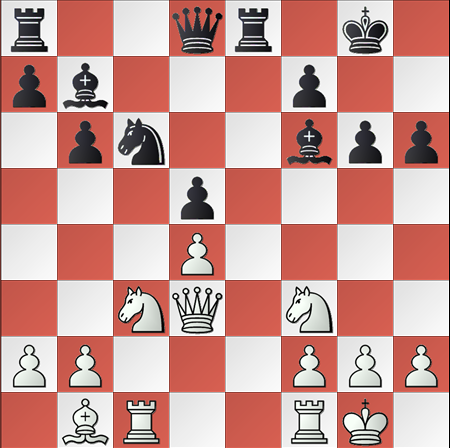
(White to move)
A cursory look at the position indicates that both the players have developed their pieces fairly well, and are in the midst of an intriguing middle game. It is obvious that White would want to move his rook to the e1 square to share the advantage of the open e file. Here comes the dilemma as to which of the two rooks – rook at c1 or the rook at f1 – that should be moved to the e1 square – is the problem.
The merits of moving the rook at f1 to e1 include – having two rooks at each side – queenside and the kingside – and exercising control over the “c” file and the “e” file. On the contrary, moving the rook at c1 to e1 means the rook at f1 is blocked.
White decided to go ahead with the second option of moving the rook at c1 to e1.
The moves are as follows:
16.
Rce1
Qd6
17.
Re3
….
White anticipated that an exchange of Rooks as:
1. ….. Rxe3
2. fxe3 ….. would strengthen his position with the Rook at f1
17.
….
Bg7
Black did not accept the invitation for exchange
The game continued further and after another 30 moves or more, both the players agreed for a draw.
This is a nice example, which emphasizes that every move, especially the wrong ones such as this one by white, should be judged on its merits.